



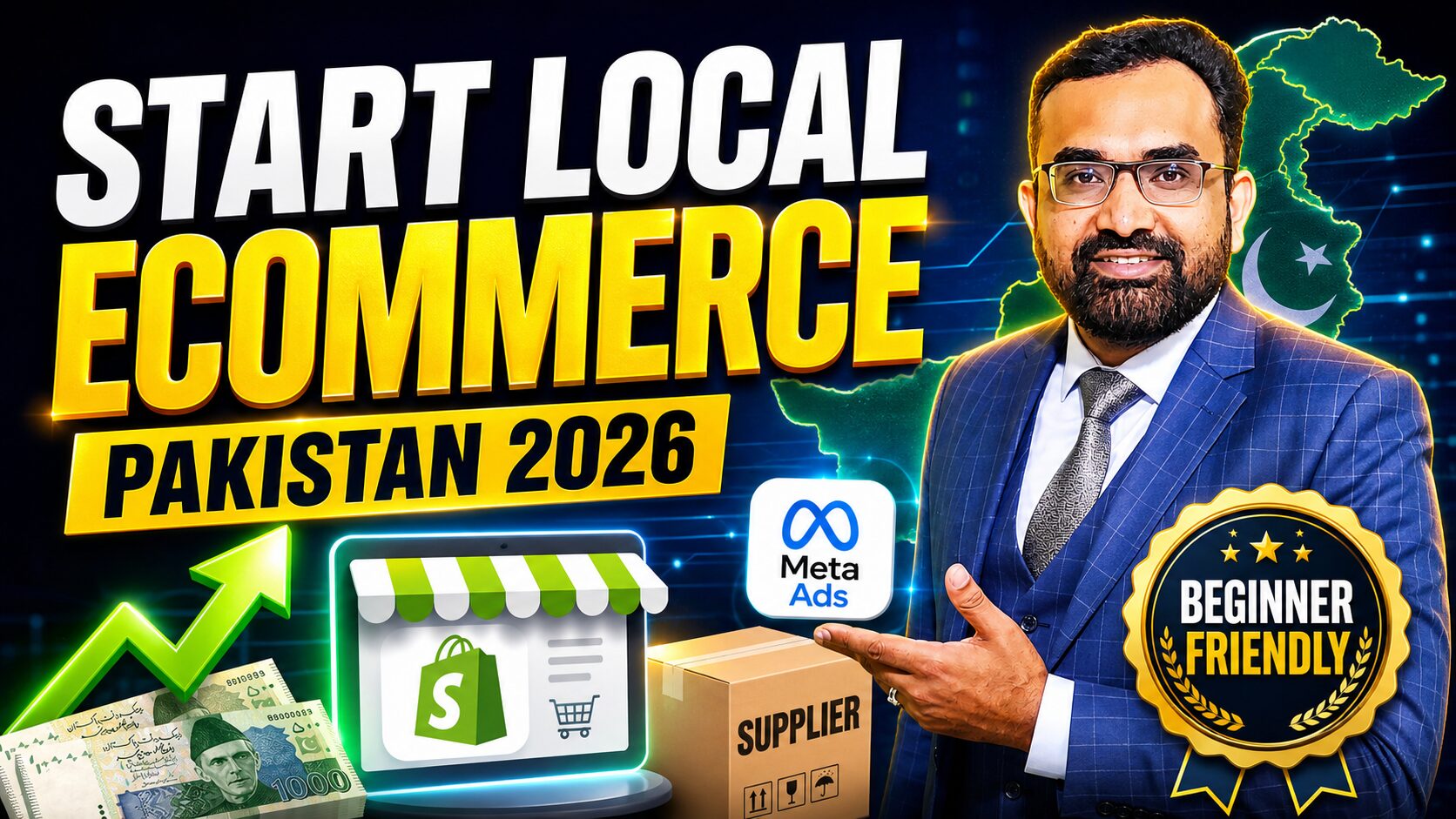
I started my first venture in a garage, surrounded by boxes and a single laptop. Back then, like many of you, I was told that launching a brand required 40 to 50 lakh PKR in “brick-and-mortar” capital. That is a myth. In 2026, the most significant barrier to entry isn’t your bank balance; it is your mindset. Most traditional ventures fail today because their cost structures are unsustainable, not because their ideas are weak.
The solution is the Local Ecommerce Business, a model that prioritizes agility over infrastructure. This guide is your senior-level roadmap to transitioning from a “Get Rich Quick” mentality to a “Skill Building” powerhouse. We will cover the Triple D framework (Data, Derivation, Decision), sourcing diplomacy in Pakistan’s biggest markets, and why your product page is the only “Home Page” that matters.
Key Takeaways
- Physical vs. Digital: Why 500 PKR/day in ads beats a 50 Lakh PKR shop-front.
- The 90% Rule: Why most fail due to the wrong model, not the wrong product.
- Pain over Product: Solving real-world problems like back pain beats selling generic goods.
- Triple D Framework: Using Data, Derivation, and Decisions to eliminate guesswork.
- Platform Choice: Why Shopify’s $1/month trial is the ultimate beginner’s bridge.
- Conversion Focus: The Landing Page is the primary gateway for ad-driven traffic.
——————————————————————————–
Table of Contents
1. Digital vs. Traditional: Why Local E-commerce Wins
A traditional business in Lahore or Karachi requires shop advances, renovations, and staff before a single customer walks in. If you want to expand from Lahore to Islamabad, you repeat those massive expenses. A Local Ecommerce Business allows you to scale globally from a drawing room.
|
Criteria
|
Traditional Business
|
Digital E-commerce
|
|---|---|---|
|
Initial Investment
|
40–50 Lakh PKR
|
500 – 1,000 PKR daily ad spend
|
|
Scalability
|
High friction (New rent/locations)
|
Low friction (Increase ad budget)
|
|
Monthly Overhead
|
High (Rent, Bills, Salaries)
|
Low (App fees, Internet)
|
|
Marketing Reach
|
Physical Footfall (Limited)
|
Data-Driven (Global/Meta/TikTok)
|
Digital marketing offers the “Triple D” advantage. Unlike a billboard where you “fire a needle into the wind,” digital ads provide raw Data. You can Derive insights about which age group is buying, and make a Decision to optimize your budget instantly.
2. Choosing Your Business Model: Dropshipping, White Label, or Private Label?
Success in a Local Ecommerce Business depends on choosing the right phase for your skill level.
- Dropshipping (Skill-Building): Use this to learn Meta Ads and customer management without inventory risk. It has lower margins, but it’s where you master the art of “selling.”
- White Label (The Middle Ground): Once you have confidence, buy 50–100 units from hubs like Shah Alam Market or Hall Road. You hold the stock, improve the margins, and control the shipping speed.
- Private Label (Asset Building): This is the ultimate goal. You add your branding, logo, and custom packaging. This builds a “Digital Asset” that you can eventually sell or register as a formal company.
Pro Tip: When sourcing from local hubs like Akbari Mandi or Bolton Market, never tell suppliers you are an “online seller.” They may label you a “window shopper” or hike prices. Tell them you have a physical shop to secure the best wholesale rates.
3. Mastering Product Hunting: The “Pain Point” Strategy
Stop looking for “Winning Products” and start looking for “Pain Points.” A senior strategist uses the “Shark Tank Strategy”—analyzing successful pitches in India or the USA to find problems that exist in Pakistan due to demographic similarities.
Case Study: Joy Stick vs. My Freedo
- Joy Stick (Ice Pops): A brand in Pakistan saw a successful ice-pop pitch on Shark Tank India and realized the same nostalgia and heat-wave demand existed here. They scaled by professionalizing a childhood memory.
- My Freedo (Back Pain): This brand targets the “Back Pain” pain point—a universal issue for office workers and drivers. By solving a real problem, they run over 600 active ads, proving that “pain” sells better than “fashion.”
What to Avoid:
- Clothing/Jewelry: High returns due to sizing and constant trend shifts.
- Breakables: Shipping damage in Pakistan is a profit killer.
- Items > 1kg: High courier fees eat your margins.
- Generic Skin Care: High trust barrier; local customers won’t trust unknown brands with their skin.
4. Data-Driven Decisions: Using Google Trends and AI
Data eliminates the “Luck” factor. Before spending a single rupee, validate the demand.
- Google Trends: Identify “Seasonal” vs. “Evergreen” trends. For example, “Desi Ghee” and “Jackets” spike in December but crash in June. If you launch a seasonal product at the wrong time, your business will fail regardless of your skill.
- AI Validation: Use Claude or DeepSeek to find “Unmet Needs.” Ask AI to suggest products like a “Pakistan Heritage Discovery Kit” or an “Urdu Scheme Lab” for kids—ideas derived from international success stories but localized for our market.
5. Structuring Your Store for Maximum Conversions
In a Local E-commerce Business, the “Product Page” is actually your “Home Page.” Most customers come directly from a Meta or TikTok ad and never see your actual home screen.
- The Landing Page Essentials: High-quality images, star ratings, and clear pricing are mandatory.
- Trust Signals: You must include a prominent “Buy with Cash on Delivery” button. In Pakistan, over 90% of transactions are CoD.
- Psychological Hooks: Use scarcity (Limited Stock) and benefit-driven bullets. If your Click-Through Rate (CTR) is below 2%, your “Hook” or “Creative” is the failure point, not the product itself.
6. Platform Showdown: Shopify vs. WordPress (WooCommerce)
Platform selection is a business decision, not a technical one.
|
Feature
|
Shopify
|
WordPress (WooCommerce)
|
|---|---|---|
|
Startup Cost
|
$1/month (First 3 Months)
|
~40/year (Hosting/Domain)
|
|
Ease of Use
|
High (Drag & Drop)
|
Moderate (Maintenance required)
|
|
Server Reliability
|
99.9% (Never crashes during ads)
|
Dependent on Hosting (Risk of lag)
|
|
Security/SSL
|
Included
|
Manual Setup
|
The Verdict: I recommend Shopify for beginners. The $1/month trial for three months allows you to test products with zero overhead. By the time the full subscription kicks in, a successful business should easily cover the cost.
Conclusion
Building a successful Local E-commerce Business is about research, testing, and the “Triple D” framework. Don’t wait for the “perfect” idea. Start with a small testing budget of 500-1,000 PKR, find a supplier in markets like Shah Alam, and validate your first “Pain Point” product.
Subscribe to the Blogking UK newsletter for more practical, senior-level insights into the Pakistani e-commerce landscape.
——————————————————————————–
FAQ
1. What if my product doesn’t sell after launching ads?
Analyze your data. If your CTR is below 2%, your ad creative/hook is weak. If the CTR is high but there are no sales, your landing page or price is the problem.
2. How much budget do I need for initial testing?
A daily budget of 500 to 1,000 PKR is sufficient to gather enough data to make a “Triple D” decision.
3. Should I buy bulk stock immediately?
No. Order 1–2 samples to check quality. Test the marketing first; only order 50–100 units (White Label) once you have proven demand through actual orders.
4. How do I avoid being scammed by local suppliers?
Physically visit the market once. Get a visiting card and a letterhead. Use a “Shop Owner” persona rather than an “Online Seller” persona to build professional rapport.
5. Why is Shopify better than WordPress for a 2026 startup?
Server reliability. If your WordPress site lags for even 3 seconds, your Meta Ad conversion rate will drop. Shopify handles high traffic seamlessly.
6. Is the $1 Shopify deal available in Pakistan?
Yes. Shopify currently offers a trial for $1/month for the first three months, which is the perfect window to turn a profit.